Richard Feynman playing bongos, months before he died. I knew drummers were smart.
Month: November 2009
If it disagrees with experiment it is wrong.
In general we look for a new law by the following process. First we guess it. Then we compute the consequences of the guess to see what would be implied if this law that we guessed is right. Then we compare the result of the computation to nature, with experiment or experience, compare it directly with observation, to see if it works. If it disagrees with experiment it is wrong. In that simple statement is the key to science. It does not make any difference how beautiful your guess is. It does not make any difference how smart you are, who made the guess, or what his name is – if it disagrees with experiment it is wrong.
— Richard Feynman
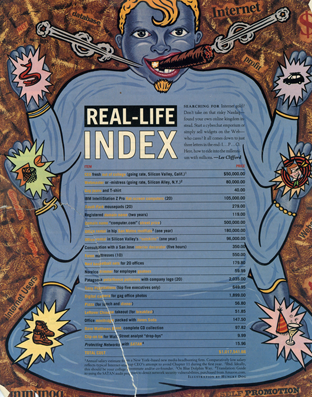
Start a company for only $1 million!
Oh, how times have changed. Anyone remember this? I’m pretty sure it was from Fast Company. I had it on my wall for years.
A close up of the actual text.
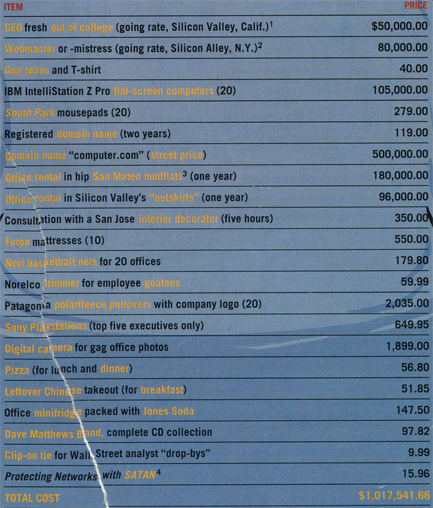
Only $119 for two years of domain registration! I’ll take five!
Full of fail.
This video is full of fail.
- No, it’s not a lambo, dude.
- No, it won’t be yours one day, dude.
- In the beginning of the video, the background music is Linkin Park
- The Veryon drives into a lake
This is the Veyron after.
Full of fail.
Thoughts from the ride
Two thoughts from the ride in this morning:
- If you want to tell where a car is going (perpendicular to you like at an intersection; parallel to you like driving ahead and possibly merging lanes), the best way to do so is by looking at their wheels. It gives you more accurate relative markings.
If a car is at an intersection and rolls forward, you’ll notice their tire rotating before you can see the car moving relative to, let’s say, a stop sign or light post.
If a car is traveling ahead of you and is merging, you’ll notice their tire moving relative to the road lines before you notice that the car body has moved towards you.
- Young people tend to accept the following statement more quickly than older people: the world is no more violent or crazy or _____ than it used to be, you’re just more aware of it due to the better spread of information (like the Internet, 24-hour news, etc).
Science at Taste
I’m going to Taste Wednesday evening for Cafe Scientifique Orlando. You should join.
Dr. Michael Hampton is a professor in the Department of Chemistry and
Director of Interdisciplinary Studies. He has been a UCF faculty member
since 1981. He also has worked in the Materials Testing Branch of
Kennedy Space Center as a Materials Engineer for NASA. He is also
currently Deputy Editor-in-Chief, “International Journal for
Alternative Fuel and Ecology”, and holds an appointment at the Florida
Solar Energy Center. His research is in the area of hydrogen storage,
sensing, purification and separation, and production. He works with
scientists in the former Soviet Union funding for peaceable research.